January 30, 2026
OK, so this is becoming a thing. You recall, I’m sure, the Martha Stewart adventure in burial themes. So here is what you need to know:
Ángel Luis Pantoja was 24 when he was found dead under a bridge in San Juan, the capital of Puerto Rico. His last wish: to be standing at his funeral. Wearing a Yankees cap and sunglasses, Pantoja was propped upright in his mother’s living room, where relatives gathered to mourn him.
You’re thinking, “Wow! That’s new!” Except:
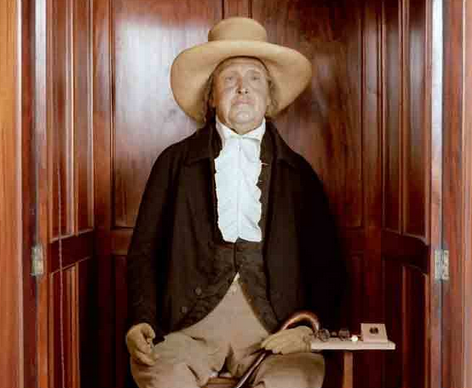
That’s Jeremy Bentham, English philosopher. Bentham requested in his will that after his death, his body be dissected for medical science, then his skeleton be preserved and dressed in his own clothes as what he called an “auto-icon”. When he died in 1832, his body was mummified and placed on display at University College London
As for Mr. Pantoja, it was a nontraditional wake spearheaded by Marin Funeral Home, whose proprietors Pantoja knew and had told of his wishes. The reception garnered significant media attention in Puerto Rico, which later extended to English and Spanish-speaking countries, from the US, where similar practices followed, to Latin America. Due to the peculiarity of Pantoja’s pose, he was often referred to as the El Muerto Para’o, or dead man standing.
Since then, more than 12 people in Puerto Rico have had velorios exóticos, or exotic wakes, according to a recently published book on the phenomenon by academic Luis Javier Cintrón-Gutiérrez. The book examines this funeral event and other more recent exotic rituals, situating the phenomenon within the broader expansion of capitalism, in which death itself becomes a commodity.
Only a gearhead academic, trying to find a tiny niche in an avalanche of professional papers, could equate being mummified with capitalism, but capitalism does encourage innovation!
“There are many groups that take advantage of death,” Cintrón-Gutiérrez says. But alternative wakes are also a way of revising existing traditions for an era of customization. Cintrón-Gutiérrez’s book primarily examines “extreme embalming” cases in which a body is positioned in a lifelike manner to capture the deceased’s personality or interests.
Other similar cases include the funeral of David “El Matatan” Morales Colón, also murdered, who at 22 became known as El Muerto en Motora, or the dead man on a motorcycle. Then there was boxer Christopher “Perrito” Rivera, whose body was propped in a simulated boxing ring during his funeral.
Violent deaths, in particular, often leave families unprepared to arrange a fitting farewell. Without prior planning, notice or funds, organizing a memorial to honor the deceased becomes a challenge. However, by creating an intimate and custom space that reflects the person’s life, mourners can learn about the individual in their final, literal “pose.” These exotic wakes open conversations about how we want to be remembered.
Historically, burials served important purposes: to protect remains and to prevent contact with potentially infectious body fluids and pathogens. Scholars also suggest that burials reveal our humanity…an awareness of mortality and the impulse to honor it.
Modern archaeological discoveries, such as the oldest known human burial in Africa, a 3-year-old-child found in Kenya, provide evidence of intentional interment dating back nearly 80,000 years. Neanderthals may have buried their dead as well, sometimes with items or in specific positions, implying ritual or symbolic thought.
Over millennia, this impulse evolved into elaborate traditions, from the Egyptian pyramids and burial tombs to Roman catacombs, medieval churchyards and the modern cemetery.
As cities grew, death became increasingly organized, sanitized and commercialized. The rise of the funeral industry in the 19th century offered order and ceremony in an age of urban anonymity. Yet the underlying act remained the same: to make sense of loss by returning the body to the earth and giving the living a ritual through which to remember.
While burial may be the norm, funeral practices vary widely across countries and cultures — from Victorian-era mourning rituals (sometimes including mandated public mourning, dress codes, and superstition, like clocks stopped at the time of death), to the famous jazz funerals in New Orleans (mourners are joined by a brass band), and Irish wakes (complete with prayer, poetry, music and drinking).
In some Tibetan communities, “sky burials” see bodies laid to rest atop remote hilltops for the vultures. In Ghana, “fantasy coffins” shaped like cars, animals, or other objects reflect the trade or passion of the deceased.
This is my favorite: In Indonesia’s Toraja region, families may keep mummified relatives at home for years, dressing and “feeding” them until an eventual communal celebration of release. Imagine grandpa sitting at your dinner party?
These traditions of course indicate that the desire to control how one is remembered, whether through beauty, spectacle or spiritual meaning, is nothing new. Death rituals, like life itself, are social mirrors.
Just over 58% of Americans report attending funerals in nontraditional venues, according to the National Funeral Directors Association (NFDA), including outdoor settings, cemeteries, private residences and public venues. By 2045, cremations are projected to account for about 82% of deaths, outnumbering burials 6 to 1, according to the association.
The job of the nearly 24,000 morticians and undertakers employed in the US, according to NFDA President Dan Ford, is to make sure they offer whatever it is a family needs to grieve. Me, I’m thinking the job is to make a profit?
Although the extreme embalming practice explored in Cintrón-Gutiérrez’s book are often perceived as “uniquely Puerto Rican,” they have antecedents elsewhere and throughout history. In that sense, media coverage and social media attention can help normalize nontraditional funerals into a symbol of community and belonging.
Pantoja’s wake took place in 2008. In a society marked by religious traditions, these wakes challenge ideas of what constitutes an “appropriate” ritual, and in doing so, opens the door to a fundamental question: How do we want to be remembered?
For me, I’m thinking about a ritual, Viking-style. Instead of being placed in a small ship and sent out to sea and set afire, I told Michael I’d like her to have me propped up in my Shelby Cobra, wearing my Cobra colors. “Put some inflatable bladders around the tires, have me towed out into the Gulf and see what happens. I think it would be a real hoot to get the reactions from passing cruise ships, so maybe a live video feed?”
Can you imagine?
“Harold, just what the hell is that out there?”
(Harold peers and squints at something bobbing in the waves)
Answer: Hombre muerto en su Shelby Cobra
If that ain’t immortality I don’t know what is.
Thoughts, questions, or reflections? I’d love to hear them. You can reach me anytime at anthony@workingprofit.com